

Company on the Moon
The small but mighty new world of commercial space exploration

This week’s exciting events on the Moon compel me to share some thoughts about the current and future role of small, entrepreneurial commercial space providers in the exploration of our solar system. Although this post does generally fit in, stay tuned for the next formal installment of “We have to get off this planet” next time...
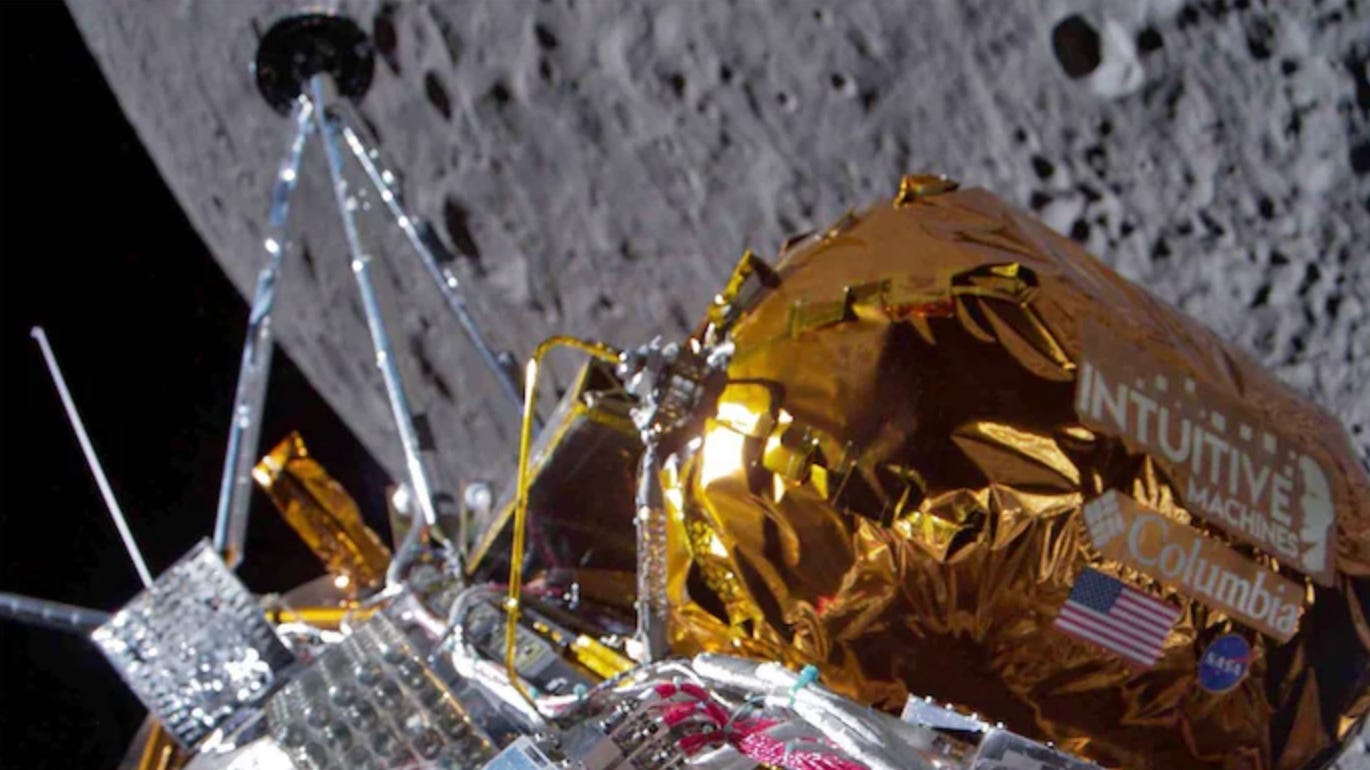
This past Thursday’s successful landing of a small robotic spacecraft on the Moon was a real reason to celebrate, a milestone event in space exploration, in my opinion. It’s special, and not only because it represents the first U.S. mission of any kind back to the lunar surface in more than 50 years.
First, it was carried out not by NASA or another major space agency, but by the employees of a small and relatively new, publicly-traded company called Intuitive Machines, based out of Houston (IM; traded on Nasdaq as LUNR). IM began as a private equity startup in 2013, went public just last year, and is loaded with talented former NASA engineers and managers, among others, who set out to try to do robotic space missions differently – specifically, at a lower price point that is more accepting of higher risk.
With apologies to legendary NASA Flight Director Gene Kranz, in the new world of small (at least at the beginning), nimble, and entrepreneurial commercial space companies, failure actually IS an option. SpaceX didn’t demonstrate a successful landing of the Falcon 9 rocket’s reusable first stage until their 9th launch, for example. Other new launch provider companies have also struggled with early failures before achieving successes. But landing on the Moon is harder than just launching a rocket, and three attempts in the past five years by privately-held companies in Israel, Japan, and the U.S. – two of which ended in crash landings on the Moon and one in a spacecraft failure while on the way – serve as a stark reminder of just how hard it is.
Still, it’s important to remember that NASA and other government-run space agencies started the same way. After all, even with the best minds on the planet focusing on the problem and funding levels motivated by the Cold War, it took five tries for the Soviets and seven tries for NASA to even crash into the Moon on purpose with a successful robotic probe in the late 1950s to early 1960s. It really IS rocket science!
Second, Thursday’s success of IM’s Odysseus lunar lander actually DOES represent a success for NASA, and for all of those in the agency who had the vision and foresight to pivot some of the agency’s precious funding to companies hired to provide services for the government. Rather than building new lunar landers at the traditional NASA Centers, the aim of the agency’s Commercial Lunar Payload Services (CLPS) program was to farm out those delivery services to commercial providers, with NASA and its science and technology payloads serving as the anchor tenant. In exchange for the lower expected cost of these commercial landers, however, NASA had to agree to accept a higher risk of failure. Indeed, the loss just last month of the first CLPS lander, an elegant spacecraft called Peregrine built by the small private company Astrobotic Technology out of Pittsburgh, is a poignant reminder of such higher risks.
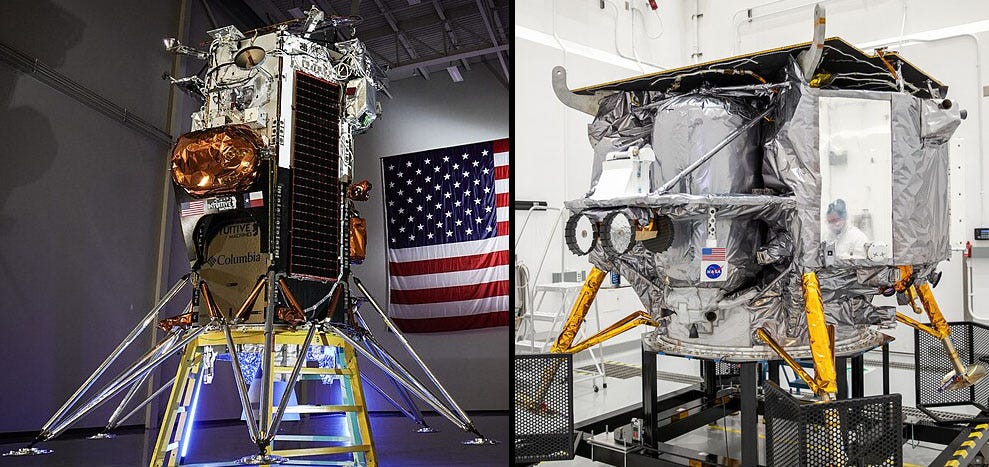
Finally, a third milestone celebration event from the successful Odysseus landing is the apparent demonstration of new opportunities realized for the space science and technology communities. Like Peregrine, Odysseus carried NASA-funded payloads to the Moon, to conduct scientific experiments like imaging and spectroscopy and to try to demonstrate new technologies that will enable even more science and engineering breakthroughs on future missions.
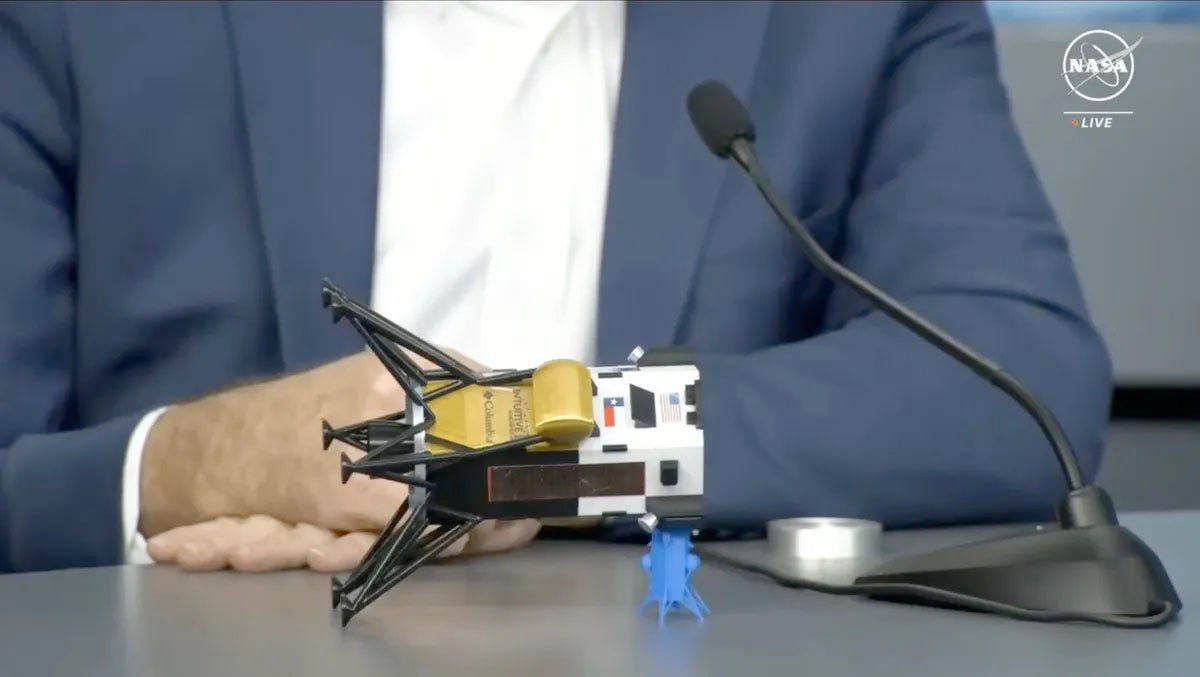
I say “apparent demonstration” above, though, because as impressive as it was for a small business to soft land a robot on the Moon and to establish reliable communications with it, IM certainly didn’t stick the landing. Based on the data downlinked so far, Odysseus appears to be on its side; after descending vertically for most of the terminal descent, it then tipped over horizontally at the very end by some as-yet unknown interaction with the surface. So for sure the jury is still out on how much science and engineering the Odysseus payloads will ultimately be able to achieve on the Moon, because of what NASA would call a “non-nominal spacecraft configuration”. Adding to the uncertainty is the fact that the lander’s expected lifetime is relatively short – the Sun will set at the lander’s location near the Moon’s south pole in about a week, and Odysseus isn’t expected to survive the frigid temperatures of the lunar night.
Still, as the test pilots say, any landing you can walk away from is a good landing. And since the NASA payloads on Peregrine, Odysseus, and other future CLPS landers were competitively selected from just a small subset of a deep pool of many dozens more proposed instruments and experiments from universities, research institutes, and government facilities around the world, the demand is certainly high for more opportunities to do NASA-funded science and engineering on the Moon.
Importantly, though, the CLPS companies can also carry non-NASA payloads to the Moon. While NASA is the anchor tenant for these companies and covers a major share of the expenses, they need other national and international customers to help pay for their landers and operations facilities and to close their business model. Odysseus, for example, carried six “commercial payloads” to the Moon, including camera payloads from Embry-Riddle Aeronautical University and the Hawaiian non-profit International Lunar Observatory Association, as well as several privately-funded art projects.
As we ramp up our visits to the Moon, there are also more human concerns that must be sorted out. Controversially, last month’s Peregrine lander carried a payload from the company Celestis that was to have delivered small vials of human remains to the lunar surface. The payload upset some members of the Navajo nation who considered it a potential desecration of the Moon, a sacred place to the Navajo People. While that payload ended up burning up in Earth’s atmosphere because of the failure of Peregrine’s propulsion system, the episode has still spurred calls for increased dialog and consideration of cultural and ethical concerns when CLPS companies consider future non-NASA payloads needed to help close their business models.
The successful, albeit untraditional, landing of the commercial spacecraft Odysseus on the Moon is cause for great celebration not only among IM employees and stockholders, but also among all of us who yearn for more frequent, innovative, and lower cost opportunities to explore our solar system. I believe that these kinds of new opportunities, in addition to a steady stream of ambitious, more traditional human and robotic exploration missions led by NASA and other governmental space agencies, will be critical to the eventual establishment of humans as an interplanetary species.